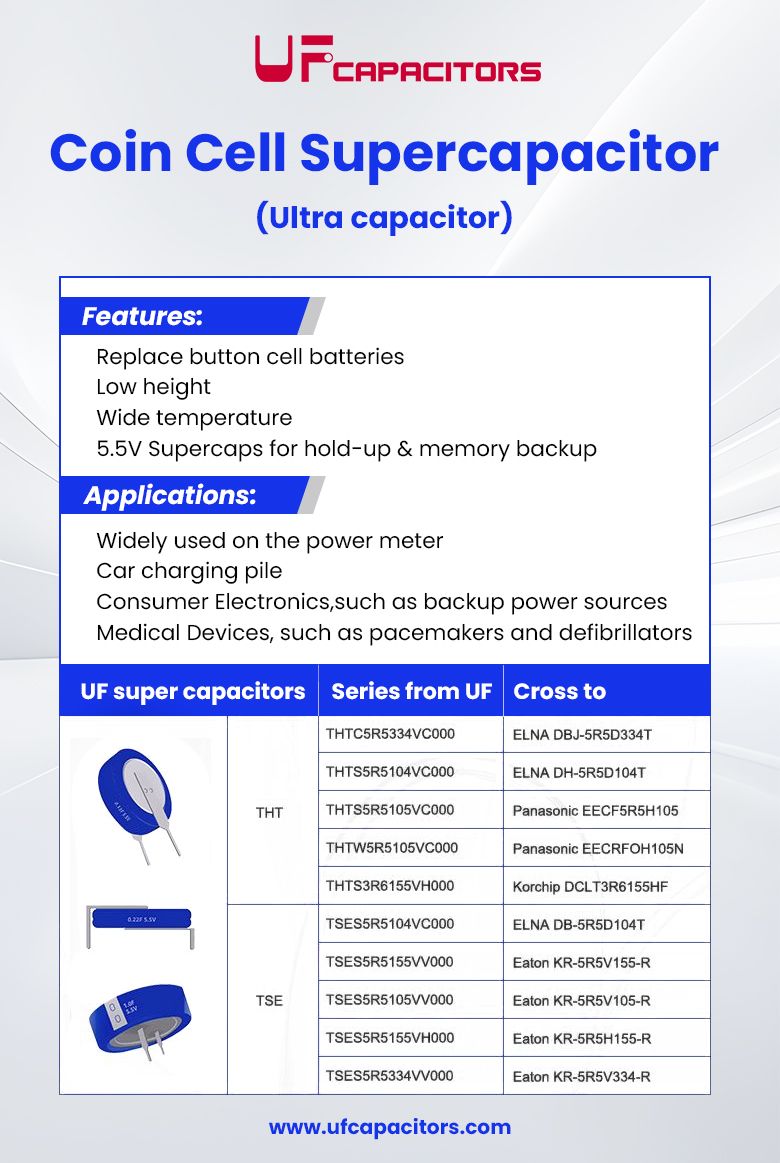


Passive supercapacitors, sometimes referred to as ultracapacitors, are innovative passive electronic components designed to store and deliver electrical energy with unique advantages over traditional capacitors and batteries. As part of the passive components lineup from UF Capacitors, supercapacitors are rapidly gaining traction in applications that demand high power, quick charging, and exceptional reliability.
What Are Passive Supercapacitors?
Passive supercapacitors are capacitors with capacitance values significantly higher than those of traditional passive capacitors such as ceramic or electrolytic capacitors. Unlike conventional capacitors that store energy through electrostatic charge on a dielectric, supercapacitors use electrochemical mechanisms—including electric double-layer capacitance (EDLC) and pseudocapacitance—to achieve much greater energy storage capacity.
This unique operation allows them to bridge the gap between capacitors and batteries: they retain the rapid charge/discharge characteristics of capacitors while offering more energy storage than typical passive components.
Core Advantages of Passive Supercapacitors
1. Extremely High Capacitance and Power Density
Supercapacitors store significantly more charge per unit volume than common passive capacitors—often tens to hundreds of times more. This makes them ideal for delivering powerful bursts of energy when needed.
2. Fast Charge and Discharge Rates
Thanks to their low internal resistance and electrochemical design, supercapacitors can charge and discharge incredibly quickly—much faster than batteries—making them perfect for applications requiring rapid energy transitions.
3. Long Cycle Life
Passive supercapacitors are capable of enduring hundreds of thousands to millions of charge-discharge cycles without significant performance degradation, far outlasting many rechargeable batteries and contributing to lower long-term maintenance.
4. Robust Safety and Reliability
Because their energy storage mechanism is physical rather than chemical, supercapacitors are typically safer and less prone to thermal runaway or degradation compared to battery technologies.
How Passive Supercapacitors Work
At the heart of every passive supercapacitor is a pair of electrodes with a large surface area, separated by an electrolyte. When voltage is applied, ions accumulate at the interface between electrodes and electrolyte, forming an electric double layer that stores charge. This mechanism enables exceptionally high capacitance compared to what is possible with traditional dielectric materials.
In some designs, pseudocapacitance occurs where fast surface redox reactions contribute to additional charge storage, further enhancing performance in specific applications.
Applications in Modern Electronics and Energy Systems
Passive supercapacitors are versatile and increasingly indispensable in a wide range of industries:
Passive Supercapacitors in UF Capacitors’ Portfolio
At UF Capacitors, supercapacitors complement a robust range of passive components including MLCCs, tantalum capacitors, film capacitors, and more. All products are manufactured with strict quality controls and are designed to meet various industry needs—from consumer electronics to industrial power systems.
The supercapacitor products from UF Capacitors feature compact designs, high capacitance density, rapid charge-discharge behavior, and extended lifespan, making them ideal choices for advanced energy storage and high-reliability applications.
Why Passive Supercapacitors Matter Today
With the global push toward smarter, more sustainable energy solutions, passive supercapacitors are becoming key enablers in energy storage innovation. They provide a complementary technology to batteries, balancing immediate power demands with long life and high efficiency.
Whether for backup systems, peak power support, or integration with renewable sources, passive supercapacitors represent a forward-looking energy storage solution aligned with future technological trends.