


A THB X2 film capacitor is a metallized polypropylene safety capacitor used across the AC mains for EMI suppression, with additional reliability performance under combined temperature, humidity and electrical bias.
A conventional humidity test can show whether a component survives moisture exposure. THB testing is more demanding because the capacitor is electrically biased during the environmental stress. That matters in real equipment that remains energized while exposed to heat and moisture.
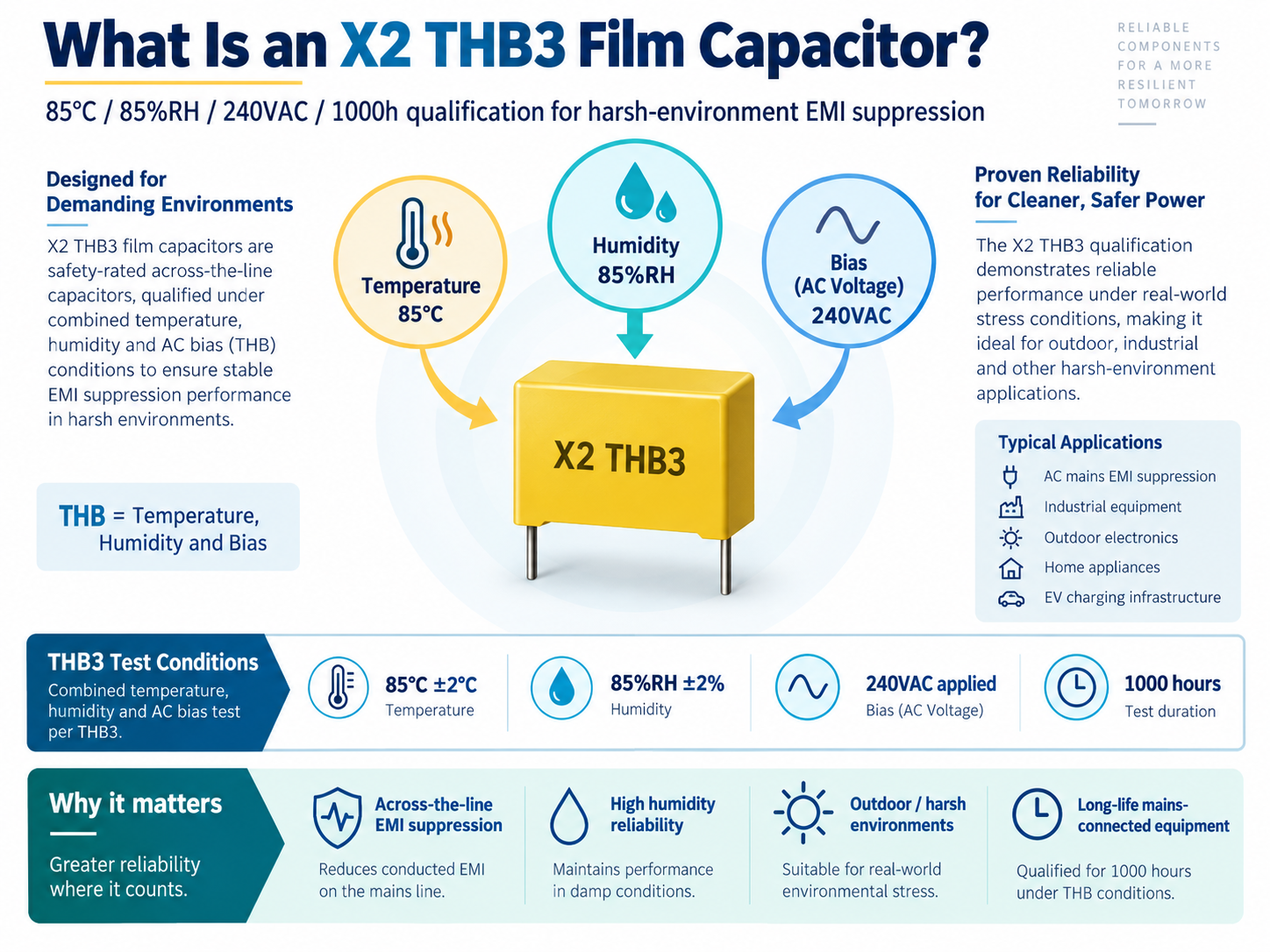
For UF's X2 THB3 series, the key qualification condition is 85°C ±2°C, 85%RH ±2%, 240VAC applied, for 1000 hours. The capacitor is not judged only by whether it still functions at the end of the test. Electrical parameters must remain within the specified post-test limits.
|
Test Element |
UF X2 THB3 Condition / Requirement |
|
Temperature |
85°C ±2°C |
|
Relative Humidity |
85%RH ±2% |
|
Applied Voltage |
240VAC |
|
Duration |
1000 hours |
|
Post-Test Evaluation |
Capacitance change, dissipation factor and insulation resistance remain within specified limits |
|
Safety Outcome |
No dielectric breakdown or flashover |
UF X2 THB3 capacitors use metallized polypropylene film in a PPS box and are available in multiple capacitance, voltage and lead-pitch combinations. This lets engineers match the EMI-filter requirement to the available PCB space.
|
Parameter |
Published UF X2 THB3 Information |
|
Capacitor Type |
Class X2 interference-suppression capacitor |
|
Dielectric |
Metallized polypropylene film |
|
Rated Voltage Options |
275VAC / 305VAC / 310VAC |
|
Operating Temperature |
-40°C to +110°C |
|
THB3 Test |
85°C / 85%RH / 240VAC / 1000h |
|
Lead Pitch Options |
10 / 15 / 20 / 22.5 / 27.5mm |
|
Typical Mounting |
Radial box-type, PCB through-hole |
|
Primary Function |
Across-the-line EMI suppression / AC input filtering |
Because an X2 capacitor is connected directly across the AC line, safety certification is part of component selection. UF's specification lists the following approval systems for the X2 THB family:
The applicable approval depends on the exact capacitance, voltage and product configuration. Engineers should verify the current certificate and exact approved part before releasing a component for production.
A useful reliability page should not reduce THB3 to one humidity number. The UF specification also includes broader environmental and electrical tests intended to evaluate the capacitor under repeated temperature, humidity and voltage stress.
|
Reliability Area |
Published Test / Evaluation |
|
Temperature Cycling |
Repeated exposure from approximately -40°C to +110°C |
|
Damp Heat, Steady State |
40°C / 90-95%RH / 56 days |
|
High-Temperature Life |
110°C ±3°C, 1.25Ur, 1000 hours |
|
Surge Voltage |
Included in reliability specification |
|
Dielectric Strength |
Included |
|
Insulation Resistance |
Included |
|
Pulse Voltage |
Included |
The metallized electrode in a film capacitor is extremely thin. This thin metallization enables self-healing, but it also makes moisture protection important. If humidity penetrates the capacitor package, the metallized layer can degrade; when moisture and electrical bias act together, the degradation process can accelerate.
Possible effects include capacitance loss, increased dissipation factor and reduced long-term insulation performance. The risk is especially relevant in outdoor power electronics that experience condensation, daily temperature swings and long energized operating periods.
Outdoor solar inverters can experience condensation, high humidity and repeated temperature changes. The X2 capacitor in the AC input or EMI filter must continue suppressing conducted interference while remaining stable over long service periods.
Industrial and infrastructure UPS equipment may remain energized continuously. THB-rated X2 capacitors are relevant in input EMI filters where humidity and long operating life must be considered together.
Drives generate substantial switching noise and conducted interference. An X2 capacitor is commonly used in the AC input EMI filter; THB performance adds environmental robustness for industrial installations.
Charging equipment is often installed outdoors or semi-outdoors. High humidity, temperature variation and long mains-connected periods make temperature-humidity-bias performance relevant to the AC-input EMI filter.
Smart meters are designed for long service intervals and may operate in uncontrolled ambient conditions. Environmental stability is important for the mains-connected interference-suppression capacitor.
Wind turbines and other renewable-energy systems combine long operating periods with humidity, condensation and temperature cycling. THB film capacitors are appropriate candidates where X2 suppression and environmental reliability are required together.
Confirm that the circuit requires an X2 capacitor connected across the line rather than a Y-class line-to-earth safety capacitor.
Match the mains and circuit requirement to the correct 275VAC, 305VAC or 310VAC part.
Select the capacitance from the EMI-filter design rather than simply replacing by physical size.
If the equipment is exposed to humidity, condensation or outdoor conditions, compare the actual THB test duration and bias conditions rather than relying only on the word 'high humidity'.
Check both operating-temperature range and any derating or application limits.
Verify the exact approval for the selected capacitance and voltage code.
Confirm lead pitch, case size, lead length and PCB clearance before production substitution.
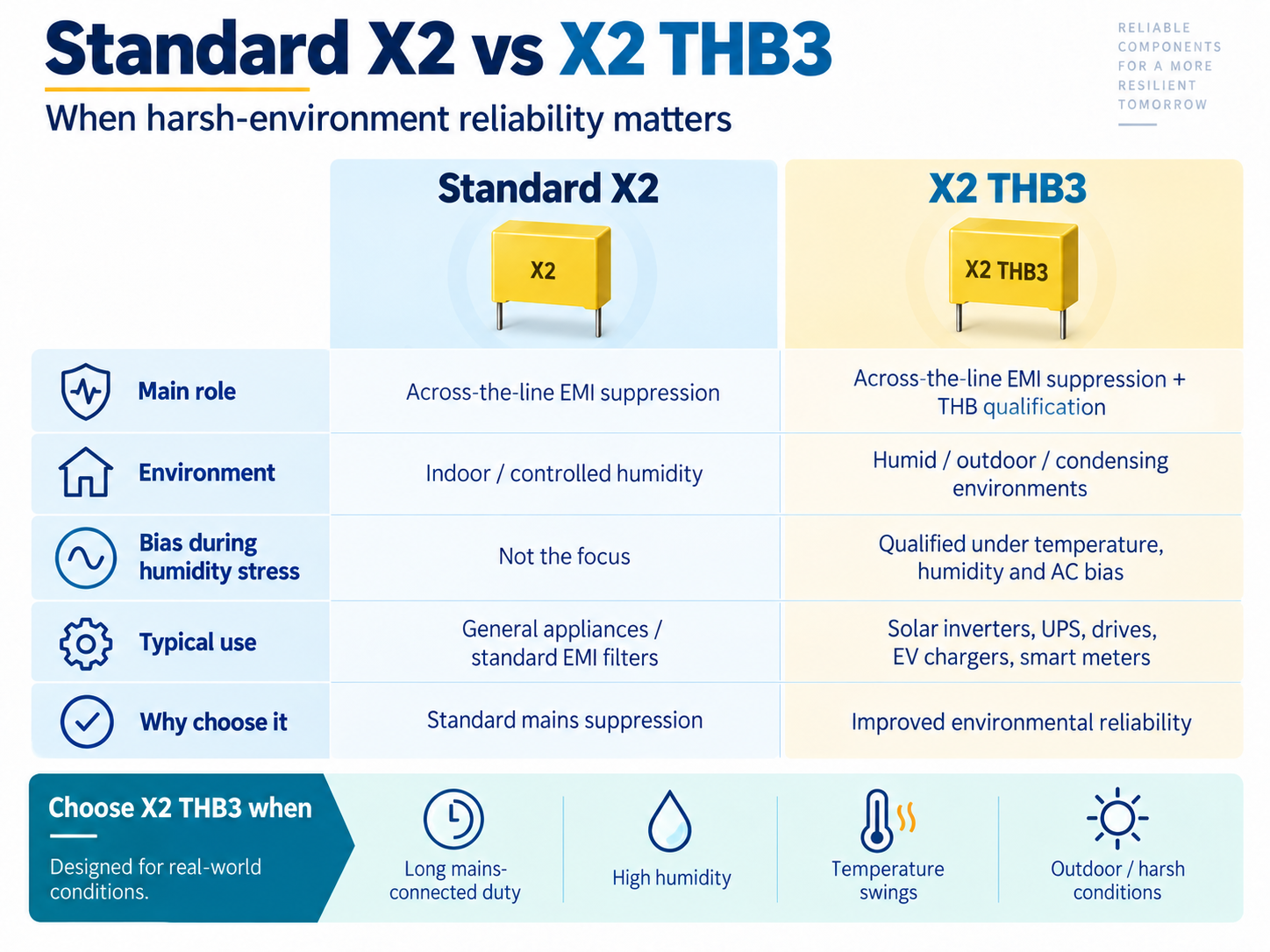
|
Selection Question |
Standard X2 May Be Sufficient When |
THB3 Is More Relevant When |
|
Environment |
Indoor, controlled humidity |
Outdoor, semi-outdoor, condensing or humid |
|
Operating Pattern |
Intermittent / moderate duty |
Long mains-connected operating periods |
|
Temperature/Humidity Combination |
Limited combined stress |
High temperature and humidity occur together |
|
Reliability Target |
Normal consumer / indoor service |
Long-life industrial / infrastructure / renewable energy |
|
Qualification Focus |
Safety + EMI function |
Safety + EMI + environmental stability under bias |
THB3 should not be presented as automatically 'better' for every circuit. It is most valuable when the application environment creates a real humidity-and-bias reliability risk.
An X2 THB3 capacitor is a Class X2 metallized polypropylene film capacitor for AC interference suppression that has been evaluated under combined temperature, humidity and electrical-bias conditions.
It refers to a test environment of 85°C temperature and 85% relative humidity. UF's X2 THB3 specification includes 240VAC applied for 1000 hours under this environment.
THB means Temperature, Humidity and Bias. The capacitor is exposed to heat and humidity while voltage is applied, which more closely represents continuously energized equipment in harsh environments.
Typical applications include solar inverters, UPS systems, motor drives, frequency converters, EV chargers, wallboxes, smart meters, wind turbines and industrial power supplies.
Outdoor equipment can experience condensation, high humidity and repeated temperature changes while remaining connected to the AC mains. THB testing evaluates capacitor stability under these combined stresses.
UF's X2 THB family includes 275VAC, 305VAC and 310VAC options depending on the exact part number.
UF supports 10mm, 15mm, 20mm, 22.5mm and 27.5mm lead-pitch configurations.
Not automatically. The replacement should match safety class, capacitance, rated voltage, approvals, case dimensions, lead pitch and circuit requirements.
No. Solar is a common example, but the same reliability concern applies to UPS systems, drives, chargers, smart meters, wind equipment and other long-life mains-connected electronics exposed to humidity.