

Metal Oxide Varistors (MOVs) are core surge protection components in electronic systems. Their maximum energy ratings, tested under different pulse waveform standards, are critical to matching specific application scenarios. The 10/1000μs and 2ms pulse standards represent two typical test criteria, differing greatly in waveform characteristics, energy - bearing mechanisms and practical uses.
First, it is essential to clarify the definitions of the two pulse waveforms. The 10/1000μs pulse is a classic surge waveform widely used in industry. Here, “10” indicates that the pulse takes 10 microseconds to rise from 0 to its peak value, and “1000” means it takes 1000 microseconds for the pulse to drop to half of the peak value after reaching the top. In contrast, the 2ms pulse refers to a long - duration waveform where the pulse duration (from the start to the half - peak point) lasts 2 milliseconds. This is much longer than the 1000μs (equivalent to 1 millisecond) duration of the former waveform.
In terms of maximum energy comparison, MOVs rated by the 2ms standard usually have a higher energy - handling capacity. The long pulse duration means the MOV has to endure the surge impact for a longer time, which requires the component to have excellent thermal stability and heat dissipation performance. If an MOV can pass the 2ms test, it proves that it can absorb large - scale energy without thermal breakdown. On the other hand, the 10/1000μs pulse has a shorter duration. The corresponding MOVs focus more on balancing response speed and medium - level energy absorption, rather than extreme long - time energy endurance.
When it comes to applications, MOVs with 10/1000μs energy ratings are widely used in general - purpose electronic and low - voltage power systems. For example, they are installed in household appliance power ports, small industrial control circuit input terminals and lighting system drivers to defend against common switching surges and lightning - induced surges in daily environments. Meanwhile, 2ms rated MOVs are designed for special scenarios that face long - duration overvoltage impacts. Typical applications include high - power motor drive systems, power distribution cabinet protection modules and renewable energy systems (such as solar inverter input ends). These fields often generate long - lasting surges when large inductive loads are switched, and only MOVs with 2ms energy ratings can provide reliable protection.
In conclusion, the key to choosing the right MOV lies in distinguishing the surge duration in practical applications. The 10/1000μs standard fits common short - duration surge scenarios, while the 2ms standard targets special long - duration surge protection needs. Proper selection can significantly improve the stability of electronic systems.
Metal Oxide Varistors (MOVs) rated by the 10/1000μs maximum energy standard are engineered to handle medium-duration surge events. This waveform defines a surge that rises to its peak in 10 microseconds and decays to half the peak in 1000 microseconds, simulating common transient overvoltages from lightning induction and inductive load switching. Below are the core application scenarios where these MOVs are irreplaceable, along with their operational logic.
1. Household Electrical Appliances
Most household devices face frequent switching surges and occasional lightning-induced overvoltages through power lines, making 10/1000μs-rated MOVs a standard protection component.
Power input terminals of large appliances: Air conditioners, refrigerators, washing machines rely on compressors or motors—inductive loads that generate voltage spikes when turned on/off. The MOV is connected in parallel at the power port; when a surge matching the 10/1000μs waveform occurs, it quickly clamps the overvoltage to a safe level, protecting the internal control board and motor drive circuit.
Small electronics: TVs, set-top boxes, and microwave ovens also integrate these MOVs. They guard against surges from grid fluctuations, preventing damage to sensitive chips and power modules.
2. Low-Voltage Industrial Control Systems
In factory environments, low-voltage control circuits (24V DC, 220V AC) are vulnerable to surges from electromagnetic interference and relay switching. 10/1000μs MOVs are widely used here:
PLC and relay control panels: Programmable Logic Controllers (PLCs) and their peripheral relay modules often trigger transient surges during switching. MOVs are installed at the input/output ports of these devices to absorb surge energy, ensuring stable operation of the control system and avoiding false triggering or hardware burnout.
Sensor and actuator protection: Proximity sensors, photoelectric sensors, and small actuators in automated production lines are connected to the grid. The 10/1000μs MOVs shield them from lightning-induced surges that propagate through signal lines or power cables.
3. Commercial Building Power Distribution and Lighting Systems
Commercial buildings such as offices and shopping malls have dense power distribution networks, where lightning surges or transformer switching surges can spread quickly:
Distribution box secondary protection: After the primary lightning arrester at the building's main distribution point, 10/1000μs MOVs are added to floor-level distribution boxes. They handle residual surges that the primary protection fails to eliminate, protecting office equipment (printers, servers) and lighting fixtures.
LED lighting systems: LED drivers are sensitive to voltage fluctuations. The 10/1000μs MOVs are integrated into the driver circuit to absorb switching surges from the grid, extending the service life of LED panels and preventing flicker or burnout.
4. Telecommunication Base Station Auxiliary Equipment
While core communication equipment uses specialized surge protectors, auxiliary systems of base stations rely on 10/1000μs MOVs:
Power supply units for ventilation and cooling systems: Base station fans and air conditioners need stable power. MOVs protect their power circuits from surges transmitted through the power grid, ensuring continuous operation of cooling systems and preventing overheating of core communication devices.
In summary, the 10/1000μs-rated MOVs are tailored for medium-energy, medium-duration surge scenarios in low-voltage systems. Their applications cover household, industrial, commercial, and telecommunication auxiliary fields, serving as a cost-effective solution for surge protection.
Metal Oxide Varistors (MOVs) rated by the 2ms maximum energy standard are designed to withstand long-duration surge events. The 2ms pulse waveform represents a transient overvoltage that lasts 2 milliseconds—twice the duration of the 10/1000μs (1ms) waveform. This makes them ideal for scenarios where inductive loads generate prolonged voltage spikes, or where grid transients persist for an extended period. Below are their core application scenarios and operational principles.
1. High-Power Motor Drive Systems
High-power motors (e.g., industrial pumps, conveyor belt motors, and HVAC compressors) are typical inductive loads that produce long-duration surges when starting, stopping, or undergoing variable-frequency adjustments. When a motor is turned off, the stored magnetic energy in the windings is released suddenly, creating a prolonged overvoltage that can damage the motor driver and control circuit.
MOVs with 2ms energy ratings are connected in parallel at the motor terminals and inverter output ports. They can absorb the sustained surge energy over 2ms without thermal breakdown, clamping the overvoltage to a safe range. This protects the insulated-gate bipolar transistors (IGBTs) in the inverter and the motor’s winding insulation.
Typical applications: Industrial water pump control systems, heavy-duty conveyor belt drives, and large air compressor motor protection.
2. Renewable Energy Generation Systems
Renewable energy systems (solar inverters, wind turbine converters) face unique long-duration surge risks from grid coupling and load switching.
Solar inverter DC-side protection: When solar panels are connected or disconnected, or during sudden changes in sunlight intensity, the DC bus voltage can generate prolonged transients. 2ms-rated MOVs are installed at the DC input terminals to absorb these surges, preventing damage to the inverter’s DC-DC conversion modules.
Wind turbine pitch control systems: The pitch motor and its drive unit produce long-duration voltage spikes during blade adjustment. MOVs with 2ms ratings shield the control circuit from these surges, ensuring stable pitch regulation even in harsh wind conditions.
3. Medium-Voltage Power Distribution and Switchgear
In medium-voltage distribution systems (3kV–35kV), switchgear operations (e.g., circuit breaker closing/opening) generate prolonged transient overvoltages that propagate through the power grid. These surges last longer than typical lightning-induced pulses, requiring MOVs with enhanced long-duration energy handling capability.
2ms-rated MOVs are integrated into medium-voltage switchgear and distribution transformers as secondary protection components. They complement primary lightning arresters by handling residual long-duration surges, protecting transformers, voltage transformers (VTs), and current transformers (CTs) from insulation damage.
Typical applications: Industrial plant medium-voltage distribution cabinets, urban substation switchgear, and rural power grid transformer protection.
4. Large-Scale UPS and Backup Power Systems
Uninterruptible Power Supplies (UPS) for data centers, hospitals, and critical industrial facilities often experience long-duration surges when switching between grid power and battery backup, or during load bank testing.
2ms-rated MOVs are installed at the UPS input and output terminals. They absorb the prolonged voltage spikes generated during mode switching, protecting the UPS’s rectifier, inverter, and battery management system (BMS). This ensures uninterrupted power supply for critical loads like medical equipment and data center servers.
In summary, 2ms-rated MOVs are tailored for long-duration, high-energy surge scenarios in high-power and medium-voltage systems. Unlike 10/1000μs MOVs for general low-voltage protection, they excel in environments where surges persist for milliseconds, providing reliable protection for heavy-duty electrical equipment.
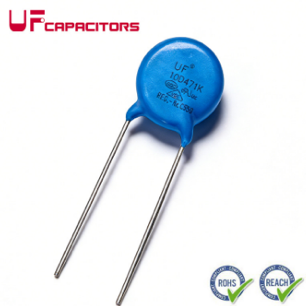
UF capacitors produces PIN to PIN alternative to Vishay, TDK/EPCOS, Panasonic and Littelfuse with better price and shorter lead time. Our products is full safety approvals: CQC UL VDE KC etc. Full series from standard, Q-series, and 6KV3KA is designed for smart meter, High surge absorption with withstands transient overvoltage (e.g., lightning/switching surges), handling up to tens of kA #Varistor
|
Photo |
Description |
Littelfuse |
Panasonic |
TDK/EPCOS |
Thinking-TVR |
|
|
Metal Oxide |
LA Varistor Series |
ERZE**D***K Series |
B722**S***K Series |
TVR Series |