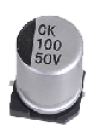


Surface-mount aluminum electrolytic capacitors are widely used in power supply filtering, decoupling, and energy buffering due to their large capacitance range, mature technology, and cost efficiency. In practical component selection, the structural differences between polarized and non-polarized aluminum electrolytic capacitors are often one of the key factors engineers need to consider, as the choice directly affects application suitability and long-term reliability.
This article explains the fundamental differences between polarized and non-polarized (Bi-Polarized / Non-polar) aluminum capacitors.
1. What Are Polarized and Non-Polarized Aluminum Capacitors?
Polarized aluminum capacitors are the most widely used type. Their key characteristics include:
- Defined positive and negative terminals
- Operation only under correct DC polarity
- Primary use in DC power filtering, decoupling, and regulation circuits
Datasheets and component markings typically show polarity symbols (⊕), Positive / Negative labels, and “For DC Voltage” indications.
Non-polarized aluminum capacitors, also referred to as Bi-Polarized or Non-polar types, feature:
- No polarity requirement during external use
- Capability to withstand AC or reverse voltage
- Typical use in audio coupling, AC signal paths, or polarity-uncertain nodes
In aluminum electrolytic technology, non-polarized capacitors are implemented using back-to-back polarized capacitor structures, hence the term “Bi-Polarized.”
2. Key Engineering Differences
|
Item |
Polarized |
Non-Polarized |
|
|
Forward DC Voltage |
Yes |
Yes |
|
|
Reverse Voltage |
No |
Yes |
|
|
AC Voltage |
No |
Yes |
|
Whether reverse or AC voltage exists in the circuit is the key factor in determining whether a non-polarized aluminum capacitor is required.
|
Item |
Polarized |
Non-Polarized |
|
ESR |
Lower |
Higher |
|
Ripple Current Capability |
Stronger |
Weaker |
|
Effective Capacitance Utilization |
Higher |
Lower (internal series structure) |
|
Size / Cost |
Smaller / Lower |
Larger / Higher |
Due to the dual-element internal structure of non-polarized aluminum capacitors, their equivalent ESR, power loss, and physical size are typically higher than those of polarized capacitors with the same ratings. This is an inherent result of the structural design.
Therefore, in pure DC power supply applications, polarized aluminum capacitors generally offer clear advantages in performance, size, and cost, while non-polarized aluminum capacitors are used to address applications involving AC signals or uncertain polarity.
3. UF Capacitors’ Product
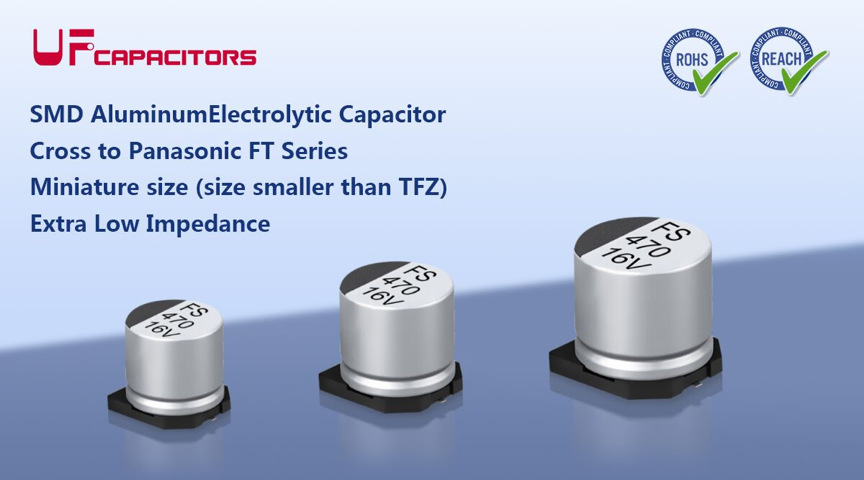
UF Capacitors focuses on polarized SMD aluminum electrolytic capacitors and polymer aluminum capacitors dedicated to DC power applications.
Positioned as a cost-effective and dependable alternative to tier-1 brands including Panasonic, Nichicon, Rubycon, and Chemi-Con, UF capacitors are developed based on well-established cross-reference designs.This enables customers to benefit from more competitive pricing and faster delivery, without compromising performance, quality, or supply stability.
Within UF’s SMD aluminum capacitor lineup, TCK and TFZ are the two flagship series.
The TCK Series is a 105°C general-purpose polarized aluminum capacitor, optimized for cost-performance balance. It is well suited for white goods, consumer power boards, and standard industrial applications.
The TFZ Series is an extra-low-impedance aluminum capacitor designed for higher reliability requirements. Meeting automotive-grade design expectations, TFZ is ideal for automotive aftermarket applications and high-end industrial power systems.
Understanding the differences between polarized and non-polarized aluminum electrolytic capacitors is essential for making informed design decisions in modern power electronics.
By selecting the appropriate capacitor structure based on voltage conditions and application requirements, engineers can optimize performance, reliability, and overall system cost.
With a focused portfolio of polarized SMD aluminum electrolytic capacitors and polymer solutions for DC power applications, UF Capacitors provides a practical, cost-effective alternative to tier-one brands, offering competitive pricing, stable quality, and shorter lead times.
For more detailed product information, datasheet, and cross-reference guidance, please visit Website:www.ufcapacitors.com.
Cross to:
|
Photo |
Description |
UF Series Code |
Rubycon |
Nichicon |
Nippon |
Panasonic |
|
|
TCK 105C V-Chip Aluminum Electrolytic |
TCK Series |
SKV Series |
UWT Series |
MVE Series |
EEEHA Series |
|
|
TFZ 105C 2000-5000 long life with extra lower impedance Aluminum Electrolytic |
TFZ Series |
TZV Series |
UUD Series |
MZA Series |
EEE-FK Series |