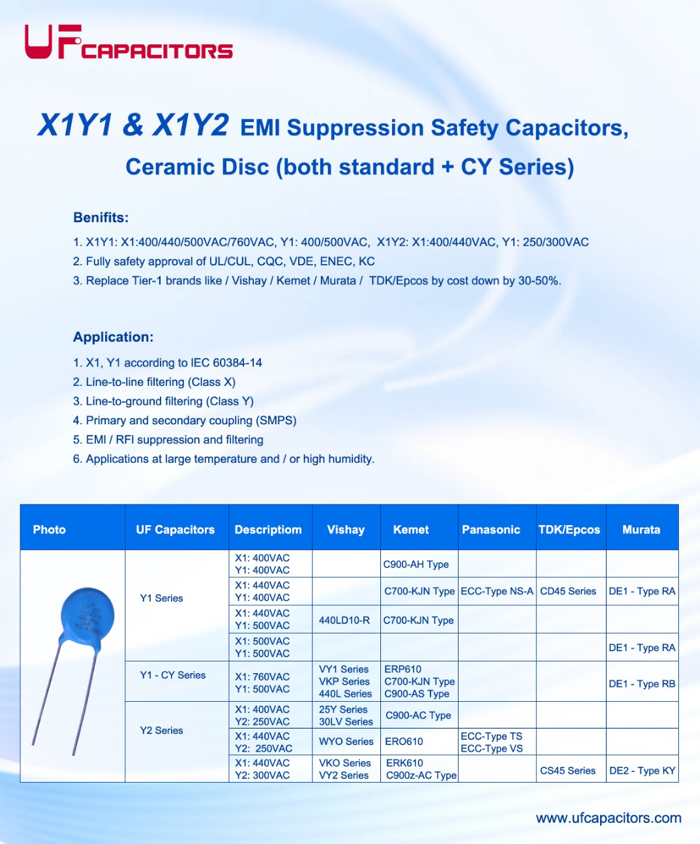


A safety capacitor is a specialized component designed for use in AC mains circuits—specifically across Line-Neutral (X capacitors) or Line-Ground/Neutral-Ground (Y capacitors). Its defining characteristic is that it must not fail in a way that endangers human life or property.
Safety capacitors are governed by international standards such as IEC 60384-14 (or GB/T 6346.14 in China) and must pass rigorous safety certifications from agencies like UL, VDE, ENEC, or CQC.
Regular capacitors, by contrast, are designed only for electrical performance. They are not tested or certified for safety in failure scenarios.
If you replace a safety capacitor with a regular capacitor, you introduce three major safety hazards.
1. Risk of Electric Shock
The Problem: Regular capacitors do not have built-in discharge requirements.
When a device is unplugged, a regular capacitor can retain a high-voltage charge for hours or even days. Anyone who touches the plug pins or opens the device for repair risks a painful—and potentially lethal—electric shock.
The Safety Standard: Safety capacitors must ensure that the voltage at the plug pins drops to below 37% of the original voltage within 2 seconds of disconnection. This rapid discharge is achieved through internal design or external bleed resistors.
2. Risk of Fire
The Problem: Regular capacitors often fail as a short circuit. When the dielectric breaks down, a low-resistance path forms, leading to excessive current, overheating, arcing, and flames. Moreover, regular capacitors typically use cases with low flame retardancy (UL94 HB or V-2), meaning they can sustain combustion and spread fire to surrounding components.
The Safety Standard: Safety capacitors are designed to fail as an open circuit. They also use materials rated UL94 V-0, which self-extinguish within 10 seconds if ignited.
3. Risk of Premature Failure
The Problem: Regular capacitors are rated for DC voltage, not AC mains voltage.
A regular capacitor labeled "400V DC" cannot withstand the continuous AC voltage peaks (up to 375V for a 250V AC line) plus transient surges (thousands of volts) that occur in real-world power grids. The result is rapid dielectric breakdown and failure.
The Safety Standard: Safety capacitors are rated for AC voltage (e.g., 250VAC or 275VAC) and are tested to withstand high-voltage pulses. An X2 capacitor, for example, must survive a pulse voltage of 2.5kV, while Y capacitors are tested at 3kV AC or 8kV DC.
|
Feature |
Safety Capacitor |
Regular Capacitor |
|
Failure Mode |
Open circuit (safe) |
Short circuit (hazardous) |
|
Discharge Time |
< 2 seconds |
Hours to days |
|
Voltage Rating |
AC (e.g., 250VAC) |
DC (e.g., 400VDC) |
|
Surge Withstand |
Tested to kV levels |
Minimal |
|
Flame Rating |
UL94 V-0 (self-extinguishing) |
UL94 HB / V-2 (can sustain fire) |
|
Safety Certification |
Mandatory (UL, VDE, CQC, ENEC) |
None |
|
Application |
AC mains input (L-N, L-G, N-G) |
Low-voltage internal circuits |
What Happens When You Use a Regular Capacitor in a Safety Role?
Consider a real-world scenario: a power supply unit (PSU) in a consumer electronic device. The designer uses a regular 0.1µF ceramic capacitor across Line and Neutral to save a few cents.
This scenario has played out in countless product recalls and electrical fires—all for the sake of a component worth less than a dollar.
To ensure you are using a proper safety capacitor, check the component body for the following:
|
Marking |
Meaning |
|
UL, VDE, ENEC, CQC logos |
Certified by recognized safety agencies |
|
X1, X2, Y1, Y2 |
Subclass indicating pulse withstand level |
|
AC voltage rating |
e.g., 275VAC, not just 400V |
|
IEC 60384-14 or GB/T 6346.14 |
Compliance with safety standards |
Physical appearance:
Replacing a safety capacitor with a regular capacitor is never acceptable. The risks—electric shock, fire, and premature failure—far outweigh any marginal cost savings. Safety capacitors are engineered to protect both the equipment and the people who use and repair it. They are designed to fail safely, discharge quickly, and resist fire.
When designing or repairing any device connected to the AC mains, always use a certified safety capacitor. It is not just a matter of regulatory compliance—it is a matter of safety.