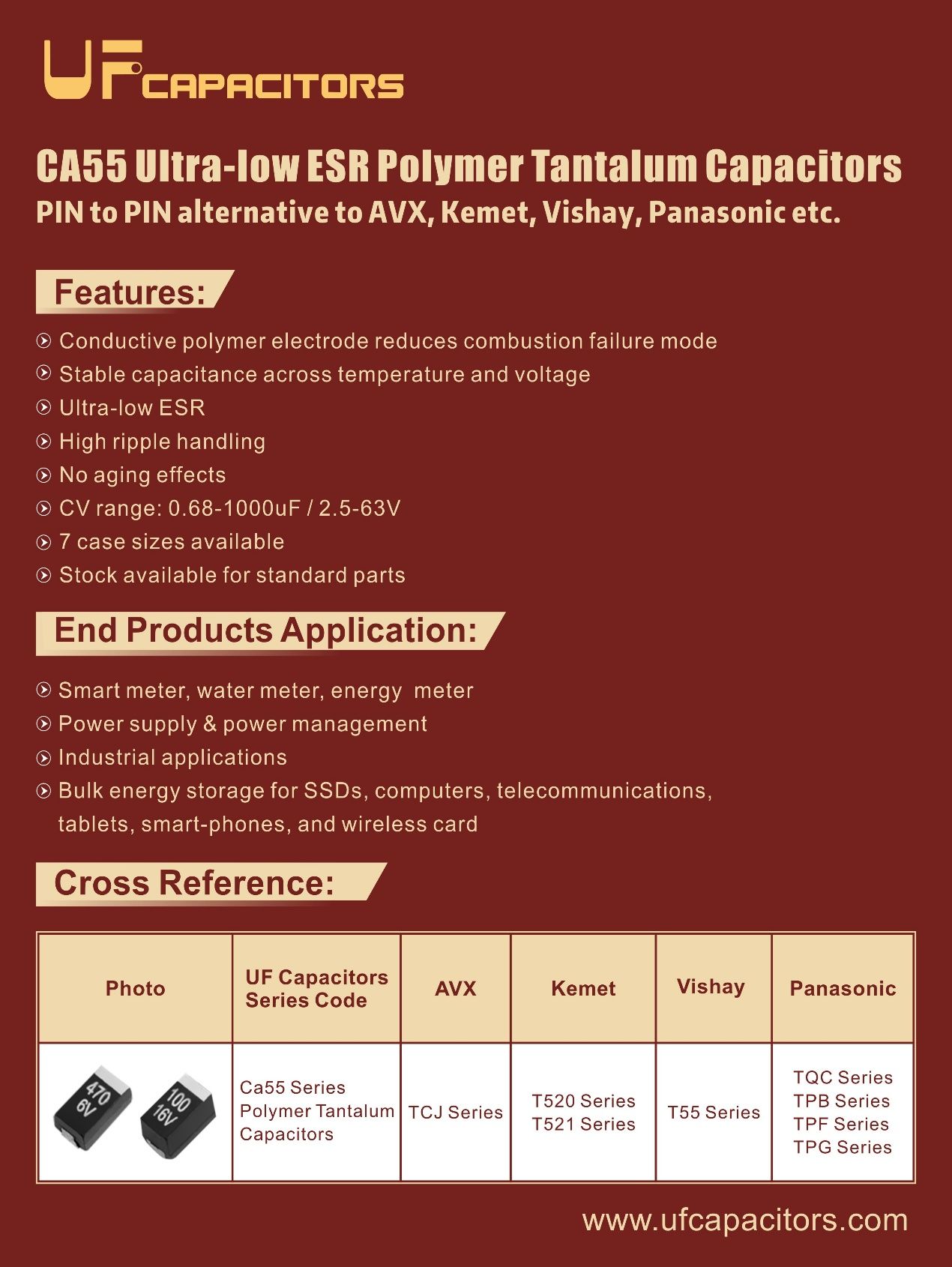


The top choice for high-performance DC-DC designs, yet engineers love and hate it for two critical weaknesses.
Introduction: The Myth of Polymer Tantalum Capacitors
In the field of power design, polymer tantalum capacitors, with their extremely low ESR, high safety, and superior high-frequency performance, have become the ideal replacement for traditional manganese dioxide (MnO₂) tantalum capacitors and some MLCCs. They are ubiquitous, from smartphones and servers to SSDs and GPU core power supplies.
However, every technology has its limitations. Like the hero Achilles who ultimately fell due to his heel, polymer tantalum capacitors also have two unavoidable "soft spots" — moisture sensitivity and limited high-temperature tolerance.
This article delves into these two core pain points, helping engineers make more informed decisions during component selection.
1.The Nature of the Problem
The cathode material of polymer tantalum capacitors — conductive polymer (e.g., PEDOT:PSS)
— is hydrophilic. When the component is exposed to high-temperature, high-humidity environments, water molecules can penetrate the interior through micro-gaps in the packaging material or along the leads, leading to:
2. Data Speaks: The Impact of Humidity on Performance
According to reliability reports from major manufacturers like KEMET and AVX:
|
Storage Condition |
Duration |
DCL Change |
ESR Change |
Capacitance Change |
|
85°C / 85% RH |
500 hours |
+300% ~ +1000% |
+50% ~ +200% |
-5% ~ -15% |
|
30°C / 60% RH |
1000 hours |
< +50% |
< +20% |
< -3% |
The data shows: The effect of moisture is non-linear. Once a critical threshold (typically 60-70% RH) is exceeded, the rate of performance degradation increases exponentially.
|
Strategy |
Implementation Method |
Effectiveness |
|
Strictly Control Storage Conditions |
Vacuum moisture-proof packaging + dry cabinet storage (<30% RH) |
Prevents damage after delivery |
|
Pre-assembly Baking |
Bake according to MSL level: 125°C for 8-24 hours |
Removes absorbed moisture, restores performance |
|
PCB Moisture Protection |
Apply conformal coating |
Creates a physical barrier layer |
|
Select Moisture-resistant Series |
Some manufacturers offer enhanced moisture-proof packages (e.g., KEMET T5XX series) |
Improves inherent moisture resistance |
3. Design and Countermeasures
Engineers can take the following measures to address moisture issues:
1. The Nature of the Problem
Polymer materials have an inherent upper limit of thermal stability:
Thermal Expansion Mismatch: Differences in coefficient of thermal expansion between the polymer and the tantalum anode create stress under repeated thermal shock.
2. Comparison: The Gap with Traditional Tantalum Capacitors
|
Parameter |
Polymer Tantalum |
Traditional MnO₂ Tantalum |
|
Recommended Max Operating Temp |
+105°C ~ +125°C |
+125°C ~ +200°C |
|
Life at 125°C |
1000 ~ 2000 hours |
2000 ~ 5000 hours |
|
Thermal Shock Tolerance (-55~125°C) |
500 ~ 1000 cycles |
1000 ~ 3000 cycles |
|
High-Temperature Derating Requirement |
10-20% |
50% (in low-impedance circuits) |
Traditional MnO₂ tantalum capacitors still hold an advantage in high-temperature applications, particularly high-temperature series like KEMET T498 and Vishay 293D.
3. Alternative Solutions for High-Temperature Scenarios
When the operating environment exceeds 125°C, engineers have the following options:
|
Solution |
Applicable Temp |
Pros and Cons |
|
High-Temperature Polymer Series (e.g., KEMET T543 HRA) |
Up to 150°C |
High cost, limited selection |
|
Traditional MnO₂ Tantalum |
Up to 200°C |
Higher ESR, requires strict derating |
|
Multilayer Ceramic Capacitors (MLCC) |
Up to 200°C |
Limited capacitance, DC bias effect |
|
Aluminum Electrolytic Capacitors |
Up to 150°C |
Large size, limited lifespan |
Polymer tantalum capacitors are a "double-edged sword" — they offer unparalleled low ESR and high-frequency performance, but come with the two major limitations of moisture and high temperature.