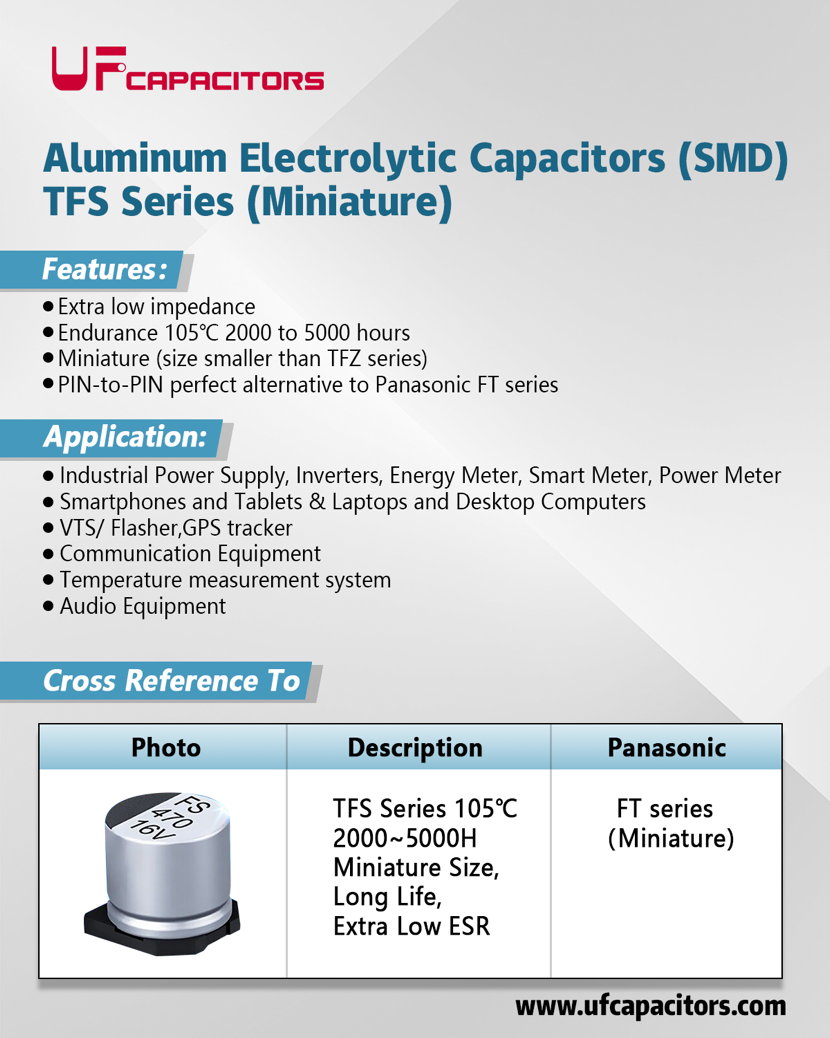


The best way to understand an SMD aluminum capacitor is to forget the complex formulas and remember one vivid analogy: a "breathing sponge."
1. Sponge → Energy Storage
Imagine a dry sponge. When you put it in water, it eagerly absorbs water (charging) and stores it in its countless pores. An SMD aluminum capacitor works the same way – when voltage is applied, it stores electric charge (electrons). When the circuit needs energy, it quickly squeezes the water out (discharging). This is its most basic energy storage function.
2. Breathing → Dynamic Operation
The word "breathing" is even more elegant – it describes the dynamic process of a capacitor in a circuit.
How important is this "breathing" in a power supply circuit?
When the voltage fluctuates, the capacitor reacts instantly:
With every inhale and exhale, the voltage is smoothed out – and that's exactly what we call power supply filtering. This is also why capacitors naturally pass AC while blocking DC.
|
Parameter |
Layman's Understanding |
Golden Rule for Selection |
|
Capacitance |
The "size" and "absorbency" of the sponge. Unit: μF (microfarads). |
Larger = stronger energy storage and filtering. But bigger isn't always better – choose based on your circuit's needs (e.g., ripple requirements). |
|
Rated Voltage |
The maximum "water pressure" the sponge can handle. Unit: V (volts). |
Always leave a margin! Select a rated voltage 1.2 - 1.5 times your actual working voltage. For a 5V circuit, use a 10V or 16V capacitor. |
|
ESR (Equivalent Series Resistance) |
The internal "friction" inside the sponge. Unit: mΩ (milliohms). |
Lower is better! Especially in high-frequency circuits like switching power supplies or CPU power delivery – you MUST choose a "Low ESR" model, otherwise the capacitor will overheat. |
Now that you understand the principle, let's get practical. For proper selection, you only need to focus on these three core parameters to avoid most common mistakes:
Despite its strengths, it has two major weaknesses. Handle with care:
1. Polarity must NOT be reversed!
SMD aluminum capacitors have polarity – they distinguish between positive and negative terminals. There is usually a colored stripe or bar on the case – that marks the negative terminal. If you install it backward, it's no longer a "sponge" but a "time bomb." It may fail, overheat, burst, or even catch fire. Never reverse polarity!
2. Not suitable for high-frequency operation
Aluminum electrolytic capacitors are inherently "slow" to respond to high-frequency signals. As a general rule, they are not recommended for frequencies above 25kHz. At high frequencies, they can transform from a capacitor into a resistor, becoming practically useless. In such cases, consider their advanced cousin – solid capacitors – or switch to non-polar ceramic capacitors.
If you've ever opened up a computer motherboard or graphics card, you might have noticed some capacitors don't have pressure relief "K" or "Y" grooves on top and feel lighter. Those are solid capacitors (polymer capacitors).
They are an "evolution" of SMD aluminum capacitors, replacing the traditional liquid electrolyte with a conductive polymer. Their advantages are significant:
Of course, they cost more. That's why you'll find solid capacitors in mission-critical areas like CPU power delivery, while traditional SMD aluminum capacitors remain the mainstream choice for cost-sensitive consumer electronics with milder operating conditions.