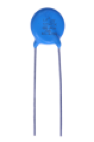


Metal-oxide varistors (MOVs) are widely used for surge protection in power supplies, lighting, home appliances, telecom equipment, industrial electronics, and metering systems. Their role is straightforward: when a transient overvoltage occurs, the MOV becomes highly conductive and limits the voltage seen by downstream circuitry by diverting surge current.
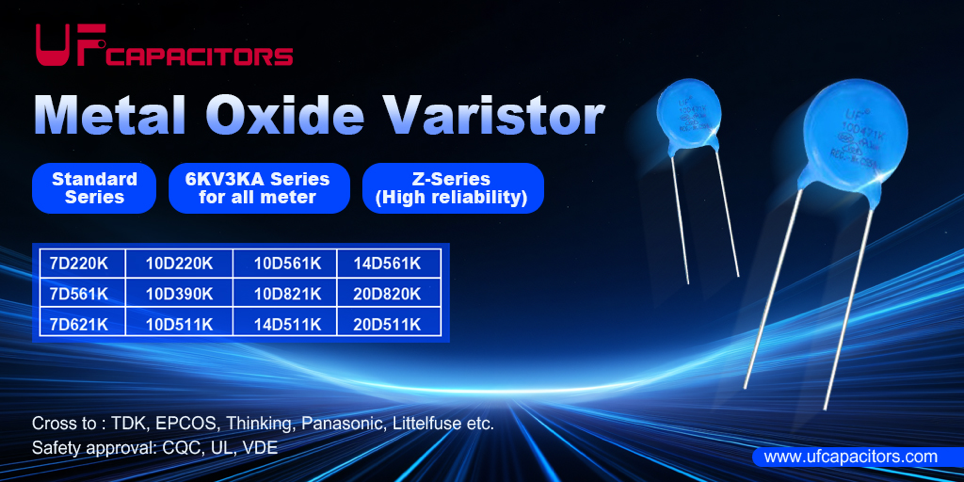
In practice, many MOV-related field issues come from parameter misinterpretation and selection errors, not from the MOV “being weak.” This article explains the most important MOV parameters—V1mA (varistor voltage), MCOV (maximum continuous operating voltage), Imax (surge current), energy rating, and clamping voltage—from an engineering perspective.
V1mA (sometimes specified at 1.0 mA DC, and in some MOV families at 0.1 mA DC) is the voltage across the MOV measured at the stated test current. In datasheets, it is typically given as a nominal value with a tolerance window (e.g., “470 V (423–517 V)”).
-Identifying the MOV “voltage class” (device-to-device comparison within a product family)
-Serving as a reference point for the MOV’s nonlinear V–I behavior and related clamping characteristics
V1mA is not the allowable continuous operating voltage.
Choosing a MOV by matching V1mA to the system’s normal line voltage can lead to excessive leakage current during normal operation, heating, accelerated aging, and eventual failure.
2.nMCOV: The First Parameter You Should Lock Down
MCOV (Maximum Continuous Operating Voltage) defines the maximum voltage the MOV can withstand continuously under normal conditions, typically stated as:
AC rms maximum allowable voltage
DC maximum allowable voltage
From a design standpoint, MCOV is the primary “can this device live here?” parameter. In the UFcapacitors VAR datasheet tables, each part number lists its maximum allowable AC rms and DC values.
Engineering guidance (general practice)
--For AC mains: select MCOV with sufficient margin for line tolerance, high-line conditions, and expected environment (temperature, long-term stress).
--For DC rails: select MCOV above the maximum steady-state rail voltage including regulation tolerance and any long-duration over-voltage conditions.
3. Imax (8/20 μs): Surge Current Capability (Not the Whole Reliability Story)
Imax is the maximum peak surge current the MOV can survive for a specified surge waveform—commonly the 8/20 μs current impulse. Datasheets typically list Imax in amperes for each part.
How to interpret Imax correctly
⚪Imax relates to single-event (or specified) surge survivability at that waveform.
⚪It does not automatically guarantee long life under repeated surges or sustained overvoltage.
⚪Real reliability also depends on the application surge environment (number of events), thermal conditions, and how much energy the MOV must absorb each time.
4. Energy Rating (J): A Strong Indicator of “How Long It Will Last” Under Repeated Events
Datasheets often specify a maximum energy rating in joules under a defined waveform (commonly 10/1000 μs). The UFcapacitors VAR tables list maximum energy values (10/1000 μs) per part number.
Practical implication:
For applications with frequent surges, energy rating is often more predictive of durability than headline Imax alone.
Larger disc sizes generally support higher energy and surge capability—reflected in the series’ multiple diameter options (e.g., 05D, 07D, 10D, 14D, 20D).
5. Clamping Voltage (Vc): What Downstream Electronics Actually “See” During a Surge
Clamping voltage (Vc) is the maximum voltage measured across the MOV during a surge test at a specified impulse current (Ip). In the UFcapacitors’ datasheet, each part includes a clamping voltage (Max.) and the corresponding test current (Ip).
Why Vc matters
⚪Lower (and more stable) clamping voltage generally means better protection for downstream ICs, power stages, and insulation systems.
⚪In system design, the downstream withstand level (e.g., MOSFET avalanche rating, IC absolute maximums, creepage/clearance constraints) should be compared to the MOV’s clamping behavior at the expected surge level.
6. Conclusion
Selecting the right MOV varistor is not simply a matter of choosing a voltage rating. A reliable surge protection design requires a clear understanding of V1mA, MCOV, Imax, energy rating, and clamping voltage, and how these parameters interact with real-world operating conditions.
By prioritizing MCOV for long-term stability, verifying surge current and energy capability for the expected environment, and ensuring that clamping voltage aligns with downstream component limits, engineers can significantly improve system robustness and service life.
Whether the application involves power supplies, lighting systems, industrial equipment, or smart metering, a structured MOV selection approach helps reduce field failures, prevent premature aging, and ensure compliance with surge protection requirements.
For designers evaluating MOV options, understanding these fundamentals is the first step toward building reliable, standards-compliant surge protection solutions.
UFcapacitors MOV Product Overview (Brief)
UFcapacitors provides three MOV series aligned to different application needs:
Standard MOV series (VAR): round, leaded zinc-oxide varistors with a wide operating temperature range (−40°C to +105°C) and available packaging options; approvals listed include CQC, UL, and VDE.
Z Series (High Energy): a dedicated high-energy offering for applications requiring increased energy handling capability.
6kV3kA Series (Metering-focused): a dedicated series intended for metering use cases that call for 6 kV / 3 kA surge requirements.
#MOV#varistors#capacitors#6KV3KA#power_supply#meter#telecom#Home_application #Varistor #Component #electronics
For application-specific recommendations or to discuss suitable MOV solutions for your design, feel free to contact us for technical support or product inquiries.
Cross reference:
|
Photo |
Description |
UF Series Code |
Vishay |
Littelfuse |
Panasonic |
TDK/EPCOS |
Thinking-TVR |
|
|
Metal Oxide |
VAR Series |
VDR Series |
LA Varistor Series |
ERZE**D***K Series |
B722**S***K Series |
TVR Series |