

Tantalum capacitors are widely used in modern electronics. They have stable performance, small size, and good reliability. Among them, the CA55 tantalum capacitor is a popular type, especially in industrial, aerospace, and military projects.
In real applications, one of the most important parameters is ESR, which means Equivalent Series Resistance. ESR has a direct influence on ripple current, voltage stability, heat generation, and capacitor lifetime.
This article will explain what ESR is, why it matters for CA55 tantalum capacitors, and how to select the right ESR value for your application.
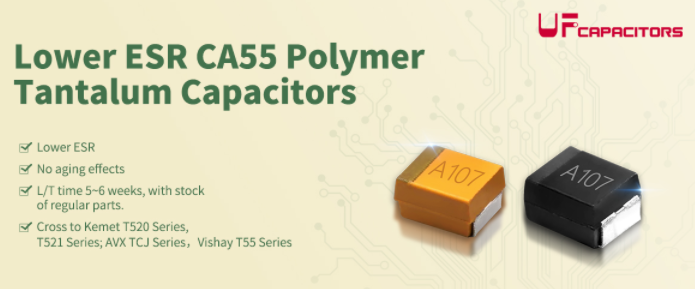
The CA55 series is a kind of solid tantalum capacitor, often designed for high reliability. Many CA55 capacitors follow military specifications and can work under wide temperature ranges, such as -55°C to +125°C.
Compared with aluminum electrolytic capacitors, CA55 tantalum capacitors offer:
In theory, a capacitor should store and release energy without loss. But in real life, every capacitor has some internal resistance. This internal resistance is called ESR.
You can think of ESR as a small resistor inside the capacitor. When current flows through the capacitor, ESR causes energy loss and heat.
The unit of ESR is usually Ohm (Ω) or milliohm (mΩ).
For CA55 tantalum capacitors, ESR depends on:
Capacitance and voltage rating
Package size
Manufacturing process
Frequency and temperature
ESR is not just a number in the datasheet. It strongly affects how the capacitor behaves in real circuits.
Remember:
✅ Lower ESR is usually better, but not always necessary.
✅ Higher ESR may cause problems in high current or high frequency circuits.
1) ESR Affects Ripple Current and Heating
Ripple current means the AC current flowing through the capacitor when the power supply is not pure DC. In switching power systems, ripple current can be high.
The capacitor heat is mainly caused by ESR:
Power Loss = (Ripple Current)² × ESR
So if ripple current is high and ESR is large, the capacitor will get hot. Too much heat will:
Reduce capacitor lifetime
Cause parameter drift
Increase failure risk
Damage nearby components
That is why datasheets often show Ripple Current rating, sometimes under conditions like 100kHz Max (as shown in many CA55 datasheets).
Higher ripple current → you need lower ESR.
2) ESR Affects Output Voltage Noise
In power supply circuits, especially DC-DC converters, the capacitor is used to reduce voltage ripple. But ESR creates a ripple voltage:
Voltage Ripple = Ripple Current × ESR
So if ESR is large, output ripple will be higher, and the power supply will be noisier.
This is very important for:
CPUs / FPGA power rails
High precision analog circuits
Communication modules
Audio circuits
If you want a stable and clean voltage, choose CA55 capacitors with low ESR.
3) ESR Affects Transient Response
When load changes suddenly, the capacitor must supply fast current. Low ESR helps the capacitor respond quickly. High ESR limits this response and may cause voltage drop.
If your circuit has:
fast load changes
high peak current
switching regulators
then ESR is very important.
4) ESR Affects Stability of Switching Regulators
This is a key point many engineers forget.
Some regulators need a certain ESR range to stay stable. If ESR is too low, the control loop may oscillate. If ESR is too high, ripple becomes too large.
So in some designs:
✅ You need “low ESR but not too low”
✅ Or you must check the regulator datasheet for capacitor ESR requirement
How to Choose the Right ESR for CA55 Tantalum Capacitor
Now the big question: How to select CA55 capacitors based on ESR?
Here are practical steps.
Step 1: Identify Your Application Type
Different circuits need different ESR.
A) Power Input Filtering (General DC)
ESR requirement: Medium
Goal: reduce low-frequency ripple
Suggested: standard CA55 ESR is usually OK
B) Switching Power Output (DC-DC Converter Output)
ESR requirement: Low
Goal: reduce high-frequency ripple and heat
Suggested: choose low ESR CA55 or parallel capacitors
C) High Ripple Current Environment
ESR requirement: Very Low
Goal: avoid heating and failure
Suggested: use multiple capacitors in parallel, or consider polymer tantalum if allowed
Step 2: Check Ripple Current and Frequency
Datasheets often provide ripple current values under specific frequency (like 100kHz).
If your switching frequency is near 100kHz, the datasheet ripple rating is useful.
If frequency is higher (like 500kHz or 1MHz), ESR and ripple current rating may change.
So you should ask:
What is my ripple current?
What is my switching frequency?
What is my working temperature?
Then estimate power loss:
Loss = I² × ESR
If loss is too high, choose lower ESR or use parallel capacitors.
Step 3: Consider Temperature Effects
ESR usually increases at low temperature.
For example, at -55°C, ESR can be much higher than at room temperature. That means:
ripple voltage increases
heating may increase
performance may drop
If your product works in cold conditions, choose CA55 capacitors with better low-temperature ESR performance or use margin.
Step 4: Use Parallel Capacitors to Reduce ESR
A simple method to reduce ESR is using two capacitors in parallel.
If you put two identical capacitors in parallel:
Capacitance doubles
ESR becomes half
Ripple current handling increases
This is often the easiest way to meet ESR requirements without changing the design too much.
Step 5: Balance ESR with Cost and Size
Low ESR parts are usually more expensive. So you should not always choose the lowest ESR.
A good selection rule is:
Summary: ESR Is a Key Parameter for CA55 Capacitor Selection
The CA55 tantalum capacitor is reliable and widely used, but ESR plays a major role in performance.
ESR affects:
Ripple current capability
Heating and lifetime
Output voltage noise
Transient response
Switching regulator stability
How to choose ESR:
Understand your application type
Check ripple current and frequency
Consider temperature range
Use parallel capacitors if needed
Balance ESR, size, and cost
If you want a stable and long-life design, always include ESR analysis when selecting CA55 tantalum capacitors.
Need Help Choosing the Right CA55 Tantalum Capacitor?
If you are selecting CA55 tantalum capacitors for power supply, filtering, or high-reliability electronics, we can help you choose the right ESR and ripple current rating.
Contact us to get:
#CA55 capacitor datasheet and selection guide
ESR comparison between different voltage and capacitance values
Sample support and BOM recommendation
UF Capacitors offers fast delivery and keep regular stock for full series of tantalum capacitors, radial leaded type, SMD Tantalum capacitors, #low_ESR series solid tantalum capacitors, and polymer tantalum capacitors.
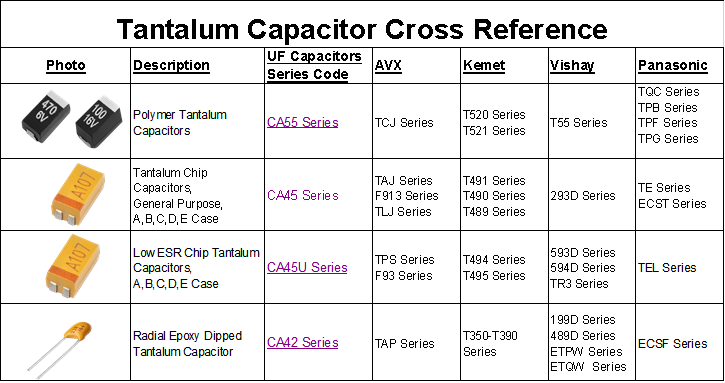
UF Capacitors’ tantalum capacitors are widely used in consumer market, industrial markets such as PCs, laptops, medical devices, audio amplifiers, cell phones, and other surface-mounted devices. UF Capacitors’ tantalum capacitors and polymer tantalum capacitors can replace #AVX Tantalum Capacitors #TAJ Series, Polymer Capacitors #AVX, #Kemet #Tantalum_Capacitors #T491 Series and #Polymer_Capacitors Kemet, #Vishay Tantalum Capacitors #293D Series, and #Panasonic #Conductive_Polymer #Tantalum_Solid Capacitors.
Below cross reference list for your reference.