

Tantalum capacitors are widely used in power supplies, smart meters, industrial control systems, and other high-reliability applications due to their stable electrical performance and high capacitance in compact size.
However, many engineers encounter a common issue:
Tantalum capacitors perform well during prototype testing but fail during mass production or field operation.
In reality: Improper derating is one of the main root causes of failure.
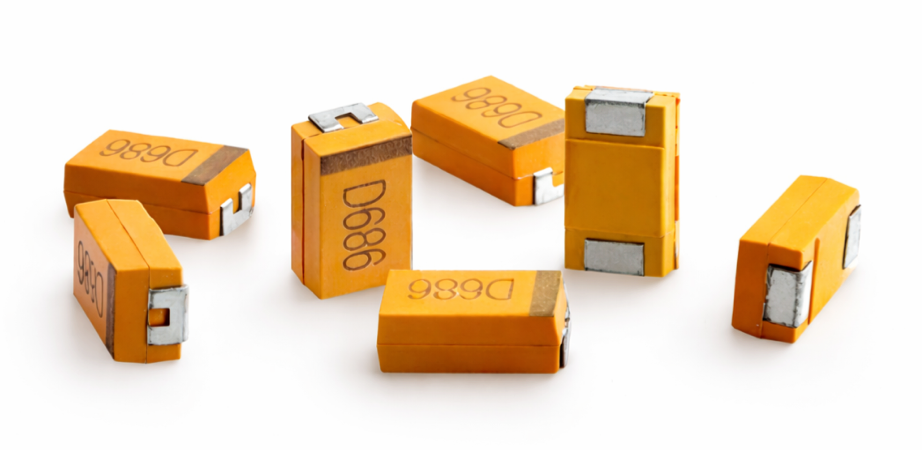
Derating refers to operating a capacitor at a voltage significantly lower than its rated voltage to improve reliability and lifespan.
Industry practice: Operate at 50%–70% of rated voltage.
Example:
Circuit voltage: 10V → Recommended capacitor: ≥20V
a. Sensitivity to Surge Voltage
Tantalum capacitors are sensitive to surge voltage and transient spikes.
Even if the nominal voltage is stable, real circuits may include:
· Power-on surge
· Switching noise
· Transient spikes
Without sufficient derating, these can exceed safe limits and lead to instant failure.
b. Increased Leakage and Thermal Stress
Operating near rated voltage increases:
* Leakage current
* Internal temperature
This accelerates degradation and may lead to:
* Thermal runaway
* Short circuit or burning
c. Lack of Safety Margin
Real-world applications are not ideal and often include:
* Temperature variation
* Ripple current
* Aging effects
Without derating, there is no safety margin, especially in industrial environments.
d. Sample vs Real Conditions
Prototype testing is usually done under controlled conditions.
However, real applications involve:
* Long operating time
* Environmental stress
* Electrical fluctuations
Without proper derating, failures often appear only in mass production or field use.
Many failures are caused by incorrect design assumptions:
- Using a 16V capacitor in a 12V circuit
- Ignoring surge voltage during startup
- Focusing only on capacitance and ESR
- Selecting components based only on price
These mistakes create hidden risks that may not appear immediately.
Voltage Derating (Key Rule)
- MnO2 tantalum: ≤50% (general), ≤30% (power circuit)
- Polymer tantalum: ≤80% (general), ≤50% (pulse)
Temperature Consideration
When operating above 85°C, additional derating must be applied.
Higher temperature → higher failure risk
Application-Based Selection
Different applications require different capacitor types:
Improper selection may lead to performance mismatch or failure
To ensure long-term reliability:
- Apply proper voltage derating
- Consider surge and real operating conditions
- Choose correct capacitor type (low leakage vs low ESR)
- Work with experienced suppliers who understand applications
At UF Capacitors, we focus on application-based capacitor selection, not just supplying components.
What We Offer:
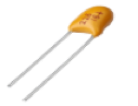
CA42 Series – Radial Epoxy Dipped Tantalum Capacitors
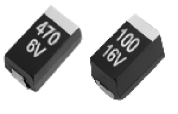
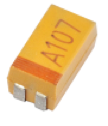
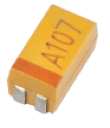
CA45 Series – Chip Tantalum Capacitors(General Purpose)
CA45U Series – Low ESR Chip Tantalum Capacitors
CA55 Series – Polymer Tantalum Capacitors
Our Strength:
- Low leakage options
- Replace AVX / Kemet / Vishay
- Short lead time and competitive pricing
Tell us your application, voltage, and target — we will help you select the right tantalum capacitor solution and support your project with reliable quality and fast delivery.
Cross to:
|
Photo |
Description |
UF Capacitors |
Kemet |
AVX |
Vishay |
|
|
Polymer Tantalum Capacitors |
CA55 Series |
T520 Series |
TCJ Series |
T55 Series |
|
|
Tantalum Chip Capacitors, |
CA45 Series |
T491 Series |
TAJ Series |
293D Series |
|
|
Low ESR Chip Tantalum Capacitors, |
CA45U Series |
T494 Series |
TPS Series |
593D Series |
|
|
Radial Epoxy Dipped Tantalum Capacitor |
CA42 Series |
T350-T390 Series |
TAP Series |
199D Series 489D Series ETPW Series |