

Most smart meters don't fail in the lab. They fail in the field — under direct sunlight, in coastal humidity, or after years of tropical rain. When they do, the root cause is often something small: an X2 capacitor that drifted out of spec, a capacitive power supply that couldn't hold regulation, or an EMI filter that lost its suppression capability.
For design engineers working on residential and industrial smart meters, the challenge is clear. You need an X2 capacitor that not only meets IEC 60384-14 safety requirements but also survives the real world. That's where the Temperature Humidity Bias (THB) test — and specifically the THB Grade III classification, the highest robustness level — becomes a non-negotiable part of the selection process.
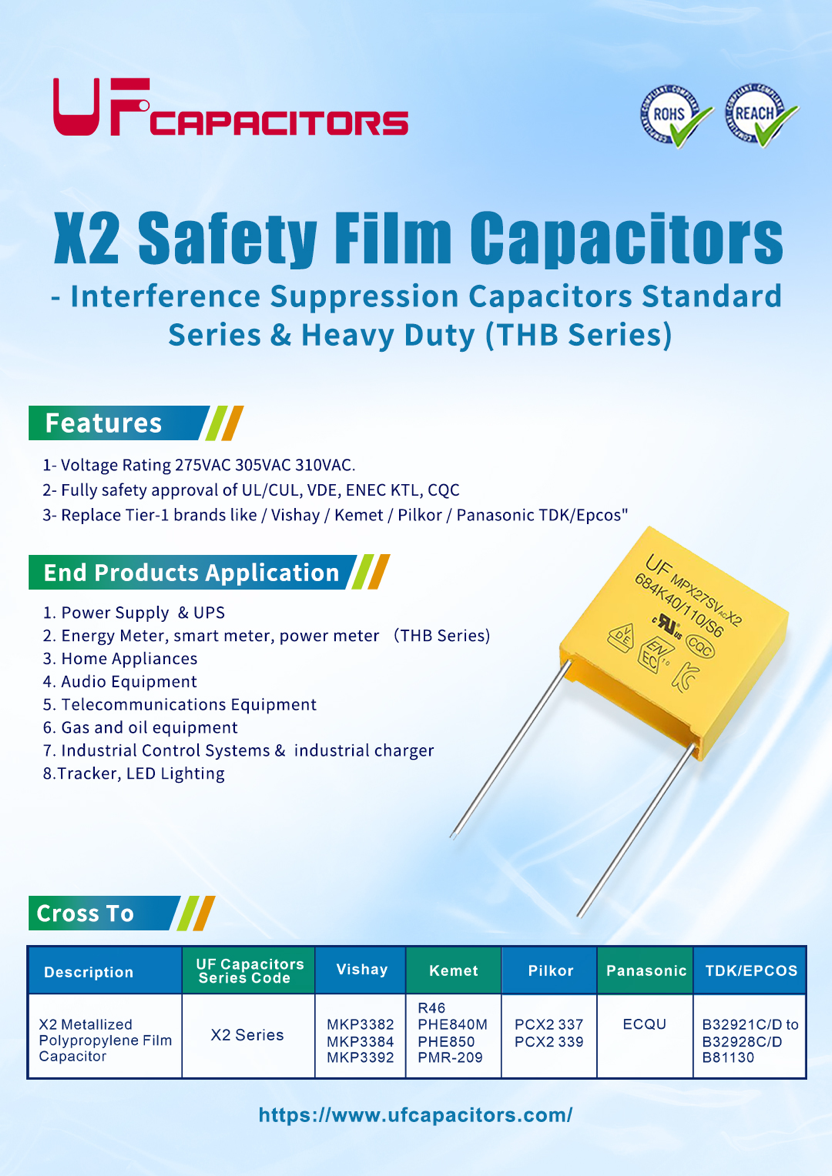
UF Capacitors designed its THB Series X2 film capacitors to solve exactly this problem. Rather than treating THB as a checkbox on a datasheet, the series was engineered around the voltage-and-humidity aging mechanisms that actually degrade capacitor performance in outdoor metering applications. The result is a component that maintains capacity stability, low dissipation factor, and high insulation resistance even after 1,000 hours at 85°C and 85% relative humidity with rated AC voltage applied.
In this article, we'll walk through the environmental stress factors unique to smart meters, explain what the THB test reveals about long-term reliability, and break down what design engineers should prioritize when selecting an X2 capacitor for meter applications.
A smart meter's operating environment is far more aggressive than that of an indoor power supply. Consider these three stress factors that work simultaneously:
Temperature Cycling
A meter installed outdoors experiences daily temperature swings. In desert regions, the internal enclosure temperature can swing from below freezing at night to over 70°C under midday sun. Every cycle stresses the capacitor's dielectric and mechanical joints.
Humidity Penetration
Humidity is the silent killer of film capacitors. Moisture ingress through the case or epoxy seal gradually degrades the metallized electrode, increasing dissipation factor and reducing insulation resistance. In coastal or tropical installations, this process accelerates dramatically.
Continuous Voltage Stress
Unlike many consumer electronics that operate intermittently, smart meters run continuously for 10 to 15 years. The X2 capacitor in a capacitive dropper circuit or EMI filter sees constant AC voltage across its terminals. When voltage stress combines with heat and humidity, the aging rate multiplies.
The THB test at 85°C / 85% RH with applied voltage is specifically designed to simulate this triple-stress condition. A capacitor that passes 1,000 hours under these conditions has demonstrated its fundamental capability to survive the real-world meter environment.
The THB test is defined within the IEC 60384-14 standard for interference suppression capacitors. It classifies capacitors into three grades based on test severity.
|
Grade |
Robustness Classification |
Test Path |
Temperature |
Relative Humidity |
Duration |
|
Grade I |
Robustness under humidity |
IA |
40°C |
93% RH |
21 days |
|
IB |
85°C |
85% RH |
168 hours (7 days) |
||
|
Grade II |
Robustness under high humidity |
IIA |
40°C |
93% RH |
56 days |
|
IIB |
85°C |
85% RH |
500 hours |
||
|
Grade III |
High robustness under high humidity (Highest) |
IIIA |
60°C |
93% RH |
56 days |
|
IIIB |
85°C |
85% RH |
1,000 hours |
Within each THB grade, Path B is the accelerated substitute for Path A.
For smart meter applications, Grade I (168 hours/21 days) and even Grade II (500 hours/56 days) may be insufficient for meters expected to operate for 10–15 years in tropical environments. Only Grade III, with its 1,000-hour test duration, provides meaningful correlation to long-term field reliability.
What Passing THB Grade III Actually Proves
After 1,000 hours at 85°C / 85% RH with 240VAC applied, a qualified capacitor must show:
Capacitance change: ≤ 10% — This ensures your capacitive dropper circuit continues delivering the expected current to the MCU and metrology chip.
Dissipation factor remains controlled — Keeping self-heating low means the capacitor isn't accelerating its own aging.
Insulation resistance: ≥ 50% of initial value — This is the safety margin. Even after years of simulated aging, the capacitor maintains enough resistance to prevent leakage currents from becoming a safety hazard.
UF Capacitors' THB Series is tested to THB Grade III — the highest robustness class — completing the 85°C / 85% RH test for 1,000 hours with rated voltage applied.
Understanding the test standard is one thing. Translating it into a reliable component is another. The UF THB Series achieves its THB Grade III performance through deliberate choices in materials, construction, and process control.
Metallized Polypropylene Film with Self-Healing Properties
The core of the capacitor is a high-purity metallized polypropylene film. Unlike polyester dielectrics, polypropylene offers inherently lower dissipation factor and superior moisture resistance. More importantly, its self-healing property means that any microscopic insulation defect caused by electrical overstress vaporizes the metallization around the fault point — isolating it without catastrophic failure.
Epoxy-Resin Vacuum Sealing
Moisture doesn't just condense on the outside; it penetrates through imperfect seals over time. The THB Series uses a vacuum-assisted epoxy resin encapsulation process that minimizes micro-voids in the sealing layer. This creates a denser, more uniform barrier against humidity ingress — the single most important defense for long-term performance in tropical environments.
Plastic Case with Flame-Retardant Rating
The outer case material is a flame-retardant plastic compatible with the IEC 60384-14 passive flammability requirements. This is not just about passing a test; it's about ensuring the meter's safety even during abnormal end-of-life conditions.
Conservative Design Margins
A capacitor rated for 305VAC that barely passes at 305VAC is a risk. The THB Series is designed with margins beyond the rated voltage, ensuring that after 1,000 hours of 85/85 testing, the insulation resistance is still at least 50% of the initial value — and in practice, often significantly higher. This margin directly translates to additional years of reliable service in the field.
Smart meters sit at the intersection of critical infrastructure and hostile environments. The X2 capacitor — small, inexpensive, and often overlooked — plays an outsized role in determining whether a meter meets its 15-year service life or fails prematurely in the field.
The UF Capacitors THB Series is purpose-built for this challenge. With verified THB Grade III performance, a construction optimized for moisture resistance, and manufacturing consistency backed by an in-house UL laboratory, it gives design engineers the confidence to specify a capacitor that matches the meter's expected lifetime.
→ Explore the UF THB Series X2 Film Capacitors at www.ufcapacitors.com
→ Download the full datasheet for detailed specifications
→ Contact our engineering team for application-specific recommendations and samples